Search
-
-
-
-
-
-
-
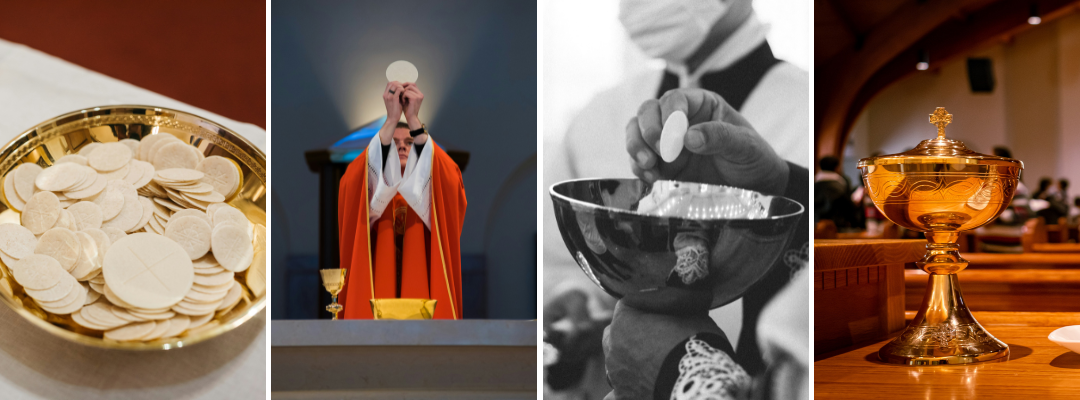
“The Eucharist is the source and summit of the Christian life.” (Lumen Gentium 11) This handbook forms Extraordinary Ministers of Holy Communion (EMHCs) in the St. John Paul II Pastorate, conforming our practice to the universal law of the Church and the particular norms of the Diocese of Madison.
-
-
-
“The Church draws her life from Christ in the Eucharist; by him she is fed and by him she is enlightened.” — Ecclesia de Eucharistia“The Eucharist, as Christ’s saving presence in the community of the faithful and its spiritual food, is the most precious possession which the Church can have in her journey through history.” — Ecclesia de Eucharistia“I consider it my duty, therefore, to appeal urgently that the liturgical norms for the celebration of the Eucharist be observed with great fidelity. These norms are a concrete expression of the authentically ecclesial nature of the Eucharist; this is their deepest meaning. Liturgy is never anyone’s private property, be it of the celebrant or of the community in which the mysteries are celebrated.” — Ecclesia de Eucharistia“There can be no danger of excess in our care for this mystery, for ‘in this sacrament is recapitulated the whole mystery of our salvation.’” — Ecclesia de Eucharistia“Therefore in Eucharistic Communion we receive Christ, Christ Himself; and our union with Him… brings it about that in Him we are also associated in the unity of His Body which is the Church.” — Dominicae Cenae“The Mystery of the Eucharist is too great for anyone to permit himself to treat it according to his own whim….” — Redemptionis SacramentumImplications for EMHCs. From this teaching flow our local practices: ministers serve only when true necessity warrants; the formula of distribution is kept intact; and the approved rites are observed faithfully out of love for Christ and for His Church.
-
-
-
Eligibility — Candidates must:
- Be Catholic and in good standing, having received Baptism, Confirmation, and the Eucharist, and manifesting devotion to the Blessed Sacrament in faith and life.
- Age: at least 18 years of age
- If married, the marriage must be recognized by the Catholic Church.
- Demonstrate spiritual maturity (habit of prayer, reverence for the liturgy, docility to the Church’s teaching and norms).
- Demonstrate physical and emotional maturity sufficient for the ministry (ability to stand and move reverently while holding the Blessed Sacrament, steadiness of hand; composure; discretion).
- Exhibit a life of Christian witness and good reputation within the parish community.
- Be reliable and punctual, willing to serve as scheduled and to prepare attentively.
- All candidates must attend a yearly training to be an EMHC
**Pastor’s discretion** Admission to this ministry is not a right; candidates are selected at the discretion of the Pastor, who judges suitability and may defer, deny, suspend, or remove a person.
-
-
-
Service when there is true need. EMHCs assist only when a sacred minister is lacking or impeded, or when the number of communicants would unduly prolong the rite of Communion.Boundaries of ministry:
- Use only the approved formula of distribution of Holy Communion.
- EMHCs do not: preside at rites reserved to sacred ministers; preach; give priestly blessings; purify sacred vessels; expose or repose the Blessed Sacrament; or retrieve the Eucharist from the tabernacle, unless given explicit permission by the pastor.
-
-
-
- Strive to be in the state of grace
- Arrive 15–20 minutes early - check in at the designated area.
- Dress: Modest, dignified Sunday attire; clean hands. No buttons, badges or other emblems endorsing any political candidate, party, or electoral issue, or that would in a general way reject the teachings of the Church.
-
-
-
A. Before Communion
- Remain with the assembly; do not gather at the altar until after the priest’s Communion.
- After the priest/deacon has received, come forward to the designated area.
- Receive Holy Communion from the priest/deacon (never self‑communicate).
- Receive the vessel from the priest/deacon; never take the vessel from the altar.
B. During Distribution- Hold the host securely between your index finger and thumb and raise it slightly above the ciborium; say only: “The Body of Christ.”
- If someone presents with arms crossed (seeking a blessing), say only "Receive Christ into your heart.” Do NOT give a blessing, do NOT touch the individual, do NOT say their name.
C. If something goes wrong- Host falls: pick up reverently and immediately consume. If there are any questions, immediately ask the priest.
- Uncertain recipient (e.g., non‑Catholic, child not yet prepared): If unsure, ask only, “Are you Catholic” If “no,” or if they are uncertain, say "Receive Christ into your heart”.
- Profanation/attempted removal: If a person begins to walk away with the Eucharist, immediately ask them to consume the host. If there are any questions, immediately ask the priest.
D. After Distribution- Return remaining hosts to the hands of the priest/deacon. If necessary only place the ciborium on the corporal on the altar.
- Purify your fingers in the ablution cup.
- Return to your place. If any incident occurred, inform the priest immediately after Mass.
-
-
-
- Children & those with disabilities: Be patient and clear; if possible ask their guardian if they receive. If unsure, say only "Receive Christ into your heart.”
- Receiving kneeling and/or the tongue: A person is never to be denied communion or asked to change their posture. EMHC must be able to administer Holy Communion on the hand or on the tongue.
-
-
-
- Communion under a single species. In this diocese, Holy Communion is usually only distributed under the species of bread alone.
- Blessings in the line. EMHC does not impart blessings.
- Tabernacle. During Mass, only the priest or deacon retrieves or reposes the Blessed Sacrament.
- Scheduling & communication. The pastorate maintains a centralized schedule at each church
-
-
-
- General Instruction of the Roman Missal (GIRM), latest typical edition and U.S. adaptation.
- Code of Canon Law (CIC), esp. can. 910 and related canons on the Eucharist.
- Redemptionis Sacramentum (Congregation for Divine Worship and the Discipline of the Sacraments, 2004).
- Ecclesia de Eucharistia (St. John Paul II, 2003).
- Instruction on Certain Questions Regarding the Collaboration of the Non‑Ordained Faithful in the Sacred Ministry of Priests (Ecclesiae de mysterio, 1997).
- Diocese of Madison: Safe Environment Policy; Office of Worship guidance for EMHCs.
-